Ergonomic Desk Height: The Complete Guide
Proper desk height is fundamental to workplace comfort, productivity, and long-term health. Yet many professionals spend years working at incorrectly positioned desks, leading to neck pain, shoulder tension, and back problems that could easily be prevented. Understanding ergonomic desk height principles and investing in a customized ergonomic desk in Dubai can transform your work experience and protect your physical wellbeing.
Why Desk Height Matters
Your desk height affects your entire body posture throughout the workday. When positioned incorrectly, you may unconsciously hunch forward, crane your neck, or elevate your shoulders to compensate, all positions that strain muscles and compress spinal structures. Over time, these postural compromises contribute to chronic pain, reduced circulation, and decreased productivity as discomfort becomes increasingly distracting.
Conversely, proper desk height allows your body to maintain neutral alignment. Your shoulders relax naturally, your spine maintains its healthy curves, and your arms rest comfortably while typing. This optimal positioning reduces fatigue, enhances focus, and minimizes the risk of repetitive strain injuries that plague office workers globally.
Calculating Your Ideal Desk Height
The standard desk height of 29-30 inches works reasonably well for people between 5’8″ and 5’10”, but anyone outside this range requires adjustment. The ergonomic ideal positions your desk so that when seated with feet flat on the floor and arms bent at 90 degrees, your forearms rest parallel to the floor with relaxed shoulders.
To calculate your optimal seated desk height, measure from the floor to the underside of your elbow while sitting with proper posture. This measurement provides your personalized baseline. For most people, this ranges from 23 inches for shorter individuals to 28 inches for taller ones. Adding keyboard thickness (typically 1-2 inches) gives you the actual desk surface height needed.
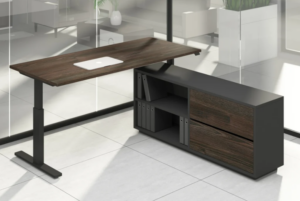
For standing desk positions, the same 90-degree elbow rule applies. Measure from the floor to your elbow while standing with good posture, this typically ranges from 38 to 46 inches depending on height. A customized ergonomic desk in Dubai can accommodate both sitting and standing positions seamlessly.
The Height-Adjustable Advantage
Fixed-height desks present limitations because body dimensions vary significantly between individuals, and even the same person benefits from position changes throughout the day. Height-adjustable desks solve both challenges by allowing precise customization to your measurements and enabling transitions between sitting and standing positions.
Modern adjustable desks feature smooth electric or pneumatic mechanisms that adjust with minimal effort. This convenience encourages regular position changes, which research shows reduces static muscle fatigue and improves circulation. Alternating between sitting and standing every 30-60 minutes provides the movement variation your body needs without disrupting workflow.
Quality adjustable desks offer memory presets that store your preferred heights, making transitions instant and consistent. This feature proves particularly valuable in shared workspaces where multiple people use the same desk, as each user can recall their personalized settings immediately.
Beyond Height: Comprehensive Ergonomic Setup
While desk height forms the foundation, complete ergonomic optimization requires attention to several complementary factors. Monitor position significantly impacts neck and eye strain, screens should sit at arm’s length distance with the top of the display at or slightly below eye level. This positioning prevents the forward head posture that contributes to cervical spine stress.
Keyboard and mouse placement affects shoulder and wrist health. These input devices should position directly in front of you at elbow height, allowing your arms to stay close to your body rather than reaching forward or to the side. Wrist rests can provide support during typing pauses but shouldn’t elevate your wrists above neutral during active keyboarding.
Chair height works in concert with desk height, your feet should rest flat on the floor or on a footrest, with thighs parallel to the ground and a small gap between the seat edge and the back of your knees. The chair’s backrest should support your lower back’s natural curve, and armrests should allow your shoulders to relax without lifting or hunching.
Investing in Long-Term Health
Choosing a customized ergonomic desk in Dubai represents an investment in your health and productivity. While premium adjustable desks cost more initially than standard fixed models, the value becomes clear when considering reduced pain, fewer medical expenses, and enhanced work performance over years of use.
Quality matters significantly in adjustable desk selection. Look for sturdy construction that remains stable at all heights, smooth adjustment mechanisms that operate quietly, sufficient weight capacity for your equipment, and a height range that accommodates your measurements both sitting and standing. Professional consultation can ensure you select specifications that match your specific requirements and workspace constraints perfectly.
Iconic Office Furniture
We are a customized solution provider for Office furniture in Dubai, UAE. We offer finest collection of Modern & Luxury office furniture. We address challenges in the office furniture industry with the right ergonomic solutions and quality products that boost productivity in the workplace.